
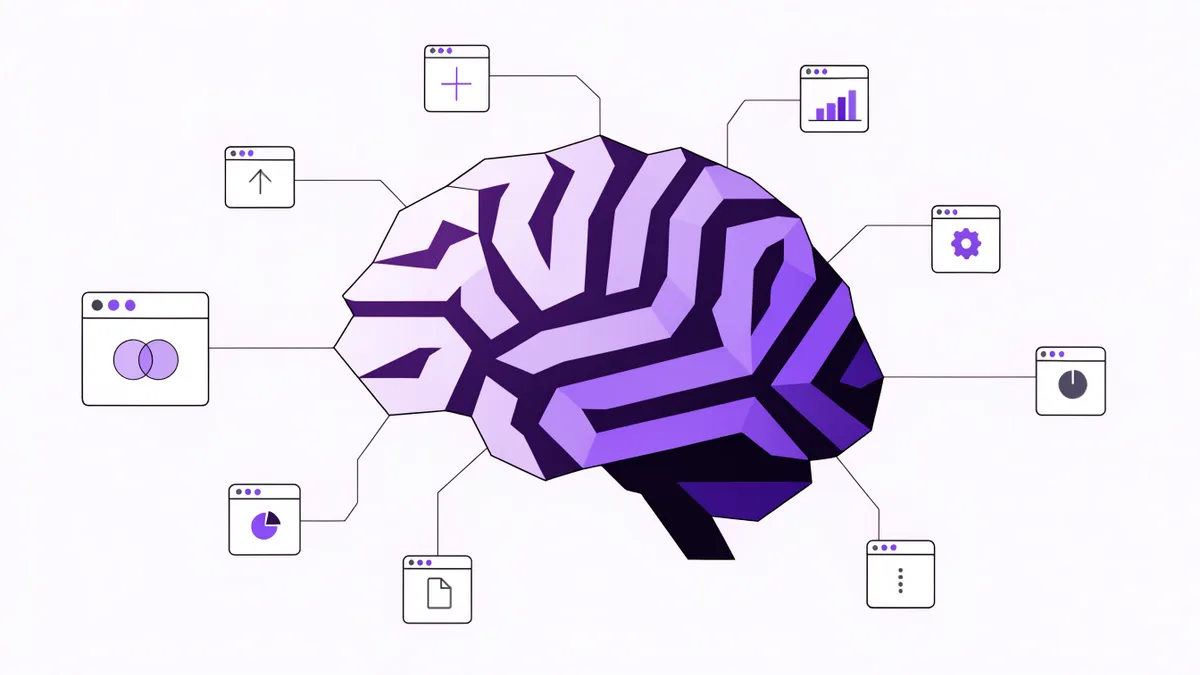
"AI business brain" sounds like a term someone in marketing invented, so let's earn it. Here is a working definition you can hold us to: an AI business brain is software that reads the tools your company already runs on, understands what it sees across all of them at once, and tells you what matters, with evidence. Not a new tool to work in. A layer that sits on top of the ones you have.
That definition has three parts, and each one rules something out.
It reads your existing tools
Your business does not live in one system. The state of a single client account is scattered: the project lives in your project management tool, the promises live in email threads, the meeting where you agreed to the deadline lives in a recording tool, and the unpaid invoice lives in your billing system. No one of those tools can see the others. Each one is confidently reporting a fraction of the truth.
Most software responds to this by asking you to migrate. The all-in-one platform pitch is really "abandon your tools and move into ours". Teams almost never do it, because the tools they have are fine at their jobs. A business brain takes the opposite bet: your tools stay, and the brain plugs on top of them, reading through each person's own connection so it only ever sees what that person can already see.
It understands, not just moves
This is where the category splits from connector tools. Zapier and Make are good software. They move data from tool A to tool B when a trigger fires, and when you need exactly that, structured plumbing between two systems, they are the right pick. But a rule cannot tell an angry client email from a newsletter. It fires on the trigger you defined, nothing more.
A brain reads content. The tone of an email, the commitment buried in a thread, the fact that the task slipping in your project tool is the same deliverable you promised a date for in writing. The test for whether something belongs in this category is simple: can it produce a finding that no single connected tool could produce on its own? "Task is overdue" is your project tool's own notification. "This task delay breaks a date we promised a client by email" is a cross-tool finding. That connection is the product. If a tool cannot make it, it is a chatbot or a connector wearing a new label.
It speaks up, and shows its work
The third part separates the category from general AI chat. ChatGPT and Claude are excellent, and this is not an intelligence argument. A general chatbot helps when you remember to ask, and only if you knew what to ask for. It also starts every conversation roughly from zero: the map of your clients, projects, and promises is yours to paste in and maintain.
A business brain watches continuously. You tell it what matters in one plain sentence, "warn me when a client email sounds unhappy, and open a ClickUp task for it", and it never stops checking. In Binee these standing instructions are called automations: watcher automations react to incoming activity in your connected tools and can carry pre-approved action steps, and scheduled automations deliver reports at a time you choose, like a morning priorities report at 8:00.
And because the findings drive real decisions, they have to be auditable. Every insight Binee produces cites the actual events behind it: the specific email, the specific task change. It refuses to store a finding it cannot back with evidence, and when a cross-check could not run, it says so instead of papering over the gap. An AI that runs part of your operations and cannot show its receipts is a liability, not a brain.
What this is not
Some honest boundaries, because a category defined only by its ambitions is worthless.
A business brain does not replace your tools. Your project tool is still where projects live. Binee reads them and, where it acts at all, acts with your approval, previewing every change first.
It does not replace your general chatbot either. Writing, research, thinking through a strategy doc: keep using what you use. The brain's job is narrower and always on, which is exactly why it can be trusted with it.
And it does not replace plumbing. If you need a form submission to become a spreadsheet row, that is a rule, and rule engines execute rules more cheaply than intelligence does. Plenty of teams run both.
Why the category exists now
The interesting question is why this is a category in 2026 and was not in 2022. The answer is that models finally got good enough at two things at once: reading unstructured content reliably (the tone of the email, the commitment in the transcript) and being honest about uncertainty. The first makes cross-tool judgment possible. The second makes it safe to run unattended.
The unglamorous truth about running a company is that most avoidable damage comes from connections nobody made in time. The delay was visible in one tool. The promise was visible in another. Nobody was looking at both on the same afternoon. A business brain is the thing that is always looking at both, and that tells you, with the evidence attached, before the client does.
That is the category. Judge any product claiming it, ours included, by the three parts: does it read the tools you already have, can it produce findings no single tool could, and does it show its work.
The Binee newsletter
One email a month: what shipped, what we learned running businesses on an AI brain, and the best new templates. No spam, unsubscribe anytime.